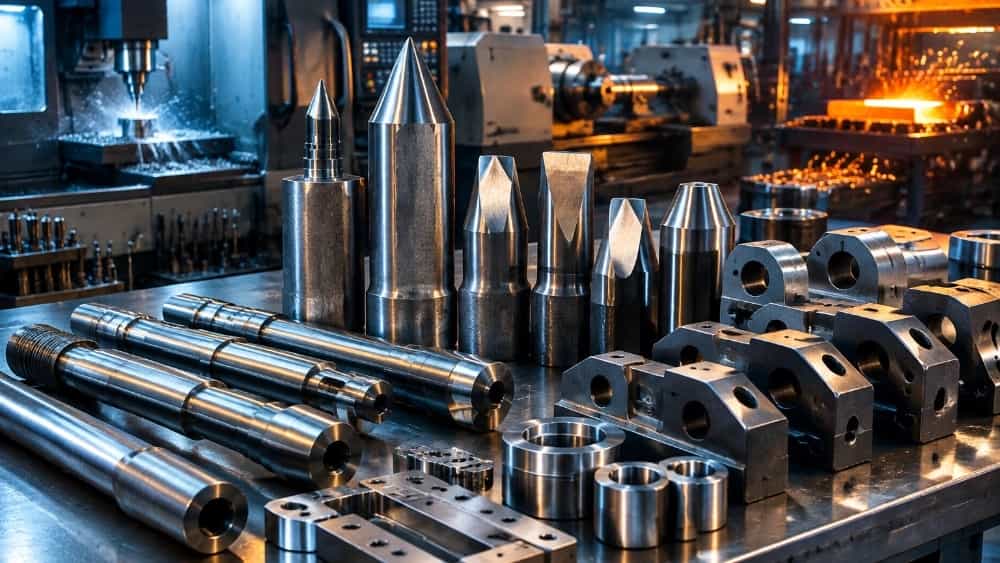
The industry of heavy machinery, road construction and mining without relying on powerful crushing and demolition equipment will practically stop. At the center of these heavy mechanical processes are hydraulic hammers that break the hardest stone and concrete volumes. The correct, continuous and faultless operation of the hydraulic hammer depends on the coordination of its internal components, and among these parts, the anvil plays a vital, impactful and strategic role. Isfahan province, as the hub of metallurgy, steelmaking and precision machining in the country, has created an irreplaceable platform for designing, reverse engineering and manufacturing super heavy mechanical parts. In this regard, the production of hydraulic hammer anvils of turned steel road construction machines in Isfahan has been able to strengthen the supply chain of construction projects all over Iran in the best possible way by relying on premium materials, modern thermal knowledge and micrometric accuracy.
The position of the anvil in the mechanical structure of the hydraulic hammer
Hydraulic hammer is an impact tool that converts oil pressure into mechanical work by receiving hydraulic fluid power from the main excavator pump. During this cycle, the piston inside the cylinder is thrown forward with high acceleration to discharge the generated kinetic energy to the final tool. The point where the piston transmits its impact to the pen is exactly where the anvil is located. The anvil is the bed that guides and distributes periodic shocks. If it does not have the appropriate geometric or metallurgical standards, the entire shock system will disintegrate in a fraction of time.
The design of the anvil should be such that shock waves are directed to the pen with the highest efficiency, and on the other hand, the reflection of destructive stresses to the cylinder, piston and valves is rejected. Any micron deviation in the seat of the anvil will lead to early wear of the body, hydraulic leakage, and ultimately the machine leaving the workshop cycle. Accurate knowledge of these subtleties has led experienced craftsmen to be drawn to reputable spare parts manufacturing centers; A powerful center that puts the famous name of manufacturing all kinds of hydraulic hammer anvils, road construction machines, steel turning in Isfahan at the forefront of employers' attention.
The strategic importance of producing hydraulic hammer anvils in Isfahan
Choosing the city of Isfahan to base the production lines of this category of parts is not just a geographical coincidence, but the result of the combination of fundamental industrial advantages:
- Direct access to the main steelmaking complexes: The presence of steel giants around Isfahan provides a platform for the supply of the best quality ingots and alloy forge blocks without intermediaries.
- Deep background in turning and molding industries: The presence of successive generations of experts in heavy tooling and precision machining has raised the production standard to the level of international competitors.
- Strategic transit location: Location in the center of the country makes it possible for road construction projects in the west, south and eastern mines to receive parts in the shortest time.
- Equipment for advanced metallurgical laboratories: Quantometric evaluation, non-destructive ultrasonic tests and hardness testing are followed in Isfahan at the highest quality level.
By combining these capabilities, Qutb Engineering manufacturing various types of hydraulic hammer anvils for road construction machines for turning steel in Isfahan has put a distinct standard of strength, repeatability and mechanical safety within the reach of the country's construction projects.
Metallurgical analysis and selection of alloy steels resistant to impact stress
Hydraulic hammer anvil operates simultaneously under two destructive phenomena: continuous mechanical crushing blows and frictional wear caused by sliding in high temperature conditions. If the used steel does not have enough flexibility and surface hardness, the part will either suffer from deformation of the edges or it will break quickly due to stress concentration. As a result, the topic of metallurgy is the cornerstone of the production process.
In the production process of hydraulic hammer anvils in Isfahan, chrome, nickel and molybdenum alloy steel blocks are used. The nickel element increases the toughness or the fracture toughness and does not allow the energy of the powerful blows to cause hairline cracks to grow. Chromium ensures deep hardenability and significantly increases the wear resistance of the metal against continuous friction. Molybdenum also maintains the stability of the granular structure at high operating temperatures.
Using forged steels with compact and homogenous graining will eliminate gas bubbles or structural microcracks; A matter that is carefully investigated and implemented by expert engineers at the center for the production of hydraulic hammer anvils, road construction machines and steel lathes in Isfahan.
Heat treatment and optimization of anvil crystal structure
Turning a raw steel section into a piece with desirable dynamic properties goes through a heat treatment furnace. No matter how much precision machining is done, if the heating, cooling and stress relief process is not basic, the life of the anvil will be very short.
The process of crystal structure optimization in the production of hydraulic hammer anvils in Isfahan includes the following steps:
- Controlled austenitizing: The part is heated to a precise temperature above the critical point so that the dissolution of the alloying elements in the base phase is completely uniform.
- Stage quenching: In order to obtain a hard martensite crystal structure, the anvil is immersed in circulating oil tanks to harden without sudden shocks.
- Multiple tempering (annealing): Quenching only causes brittle hardness, therefore the heat recovery process is carried out in several stages to remove residual stresses and create a perfect balance between surface hardness and core flexibility.
- Induction hardening on contact surfaces: In the part of the seat that meets the piston, concentrated induction hardening is used so that, while having a hard and anti-wear shell, the core of the piece is resistant to maintain the shock load.
The application of these precise scientific protocols in the production of hydraulic hammer anvils for steel road construction machines in Isfahan has guaranteed the durability of the parts even in the most challenging tunnel digging and iron ore mining projects.
Turning precision and geometric tolerances in the production of picor anvils
Modern hydraulic hammers are mechanical systems with dimensional tolerances of hundredths of a millimeter. The smallest tolerance outside of the map in the outer diameter of the anvil causes excessive slack, oil leakage, piston out of vertical alignment, and finally gearing or cylinder breakage. On the contrary, negative tolerance and very tight fitting also disturb the smooth movement of the part.
In Isfahan's advanced turning complex, the anvil forming operation is performed with modern multi-axis CNC machines. The geometry of the curved surfaces, seat conic angles, lubrication channels and rosgeneric connection methods are shaved under the supervision of highly sensitive sensors. High accuracy in concentricity and final surface finish (very little roughness) minimizes the rate of wear of felt bowls and sealing bushings. This commitment to the quality of construction has made the name production of hydraulic hammer anvils for road construction machines and steel turning in Isfahan a reliable model for heavy machinery operators.
Variety of production for world famous brands
Road construction and mining machinery active in the Middle East have a wide variety of brands. Each manufacturer implements specific standards and different dimensions in the internal arrangement of hydraulic hammers. A workshop that claims nationwide coverage must be able to produce all technical codes.
Production of hydraulic hammer anvils in Isfahan includes a huge range of commonly used anvils:
Anvil of Korean and Japanese hammers
Anvil of European and American hammers
Systems such as Montabert, Atlas Copco, Caterpillar, Krupp and Rammer generally use a more complex architecture in internal lubrication and shock wave guidance. The anvils produced for these tools, relying on European metallurgy, pass more stringent tests to maintain the safety of the piston.
The expert team production of hydraulic hammer anvils for steel road construction machinery in Isfahan by checking the comprehensive archive of original parts drawings, has the ability to manufacture any type of hydraulic hammer anvil without the slightest deviation from the fabric samples.
Factors affecting early anvil erosion and prevention strategies
Field investigation of anvil behavior in mining sites shows that the wear and destruction of mechanical parts is not only caused by the end of the natural life of the part, but also can be rooted in improper working conditions. Nevertheless, the standard part gives a much higher margin of safety to the device.
The key factors aggravating the failure of the anvil are:
- Putting in a vacuum state: The complete lack of contact of the tool with the stone causes all the impact energy to return to the anvil and piston in the form of a tensile wave; A problem that aggravates metal fatigue.
- Insufficient lubrication and dust penetration: Silica particles and gravel act like sandpaper in the absence of continuous lubrication and wear the polished surfaces of the anvil.
- Using different and non-standard anvils: Parts that are made with normal construction steels or without deep heat treatment suffer in the first hours of operation. seat crushing or diagonal cracks.
Parts from the workshop production of hydraulic hammer anvils for steel road construction machines in Isfahan due to their very high yield strength, show amazing resilience against return stresses and greatly reduce the costs of periodical repairs.
The role of resistant anvil in the economic efficiency of road construction projects
The unexpected stoppage of a heavy excavator equipped with a hydraulic hammer at a dam, road construction or mining site does not simply cost a spare part; Rather, the entire process of loading, transporting trucks and stone crushers is stopped and causes heavy financial losses. Using high-quality and engineered anvils has several strategic advantages:
- Preventing damage to the piston and cylinder, which are considered to be the most expensive parts of the hammer.
- Continuation of stone breaking efficiency due to the 100% transfer of impact force without energy loss.
- Increasing the time interval required for basic picor service and replacement of consumable parts.
- Reducing asymmetric vibrations and increasing the life of the boom and excavator rig.
Therefore, technical experts always prefer to connect their supply chain of tools directly to the first level experts; Where the core capabilities of manufacturing all kinds of hydraulic hammer anvils, road construction machinery, steel cutting in Isfahan give a definitive answer to all concerns related to depreciation in difficult working conditions.
Quality control and multi-stage technical inspections
In the process of making ultra-durable parts, no step should be left without rigorous quality tests. In the advanced industrial centers of Isfahan, quality control standards are implemented independently at each step:
- Qualitative evaluation of the incoming ingot: Chemical composition control with optical spectroscopic methods to ensure purity and full compliance with the alloy standard.
- Ultrasonic tests: Full depth scan of the forged ingot to discover any hidden microscopic holes or discontinuities in the material texture.
- Dimensional measurement with digital calipers and Precision probes: Match angles, chamfers and grooves with technical drawing tolerances.
- Rockwell and Brinell hardness tests: Continuous evaluation of shell and body to ensure the desired depth and degree of hardness are achieved after the tempering process.
Strict implementation of these protocols in the work process of the specialized unit Production of hydraulic hammer anvils for road construction machinery, turning steel in Isfahan has caused the delivered parts to be evaluated at the same level as the leading parts of the world market in terms of durability and behavioral harmony.
The prospect of self-sufficiency in the manufacture of heavy duty equipment
Nowadays, metallurgical and turning workshops in this province, by obtaining the latest methods of metallurgical hardworking and computer modeling, produce anvils with a lifespan equal to and even higher than imported samples. The series Production of hydraulic hammer anvils for steel road construction machines in Isfahan by using modern engineering capabilities, has played a leading role in supporting road construction machinery and has made the name of this province a symbol of quality, durability and precision in the industry of heavy hydraulic tools.